
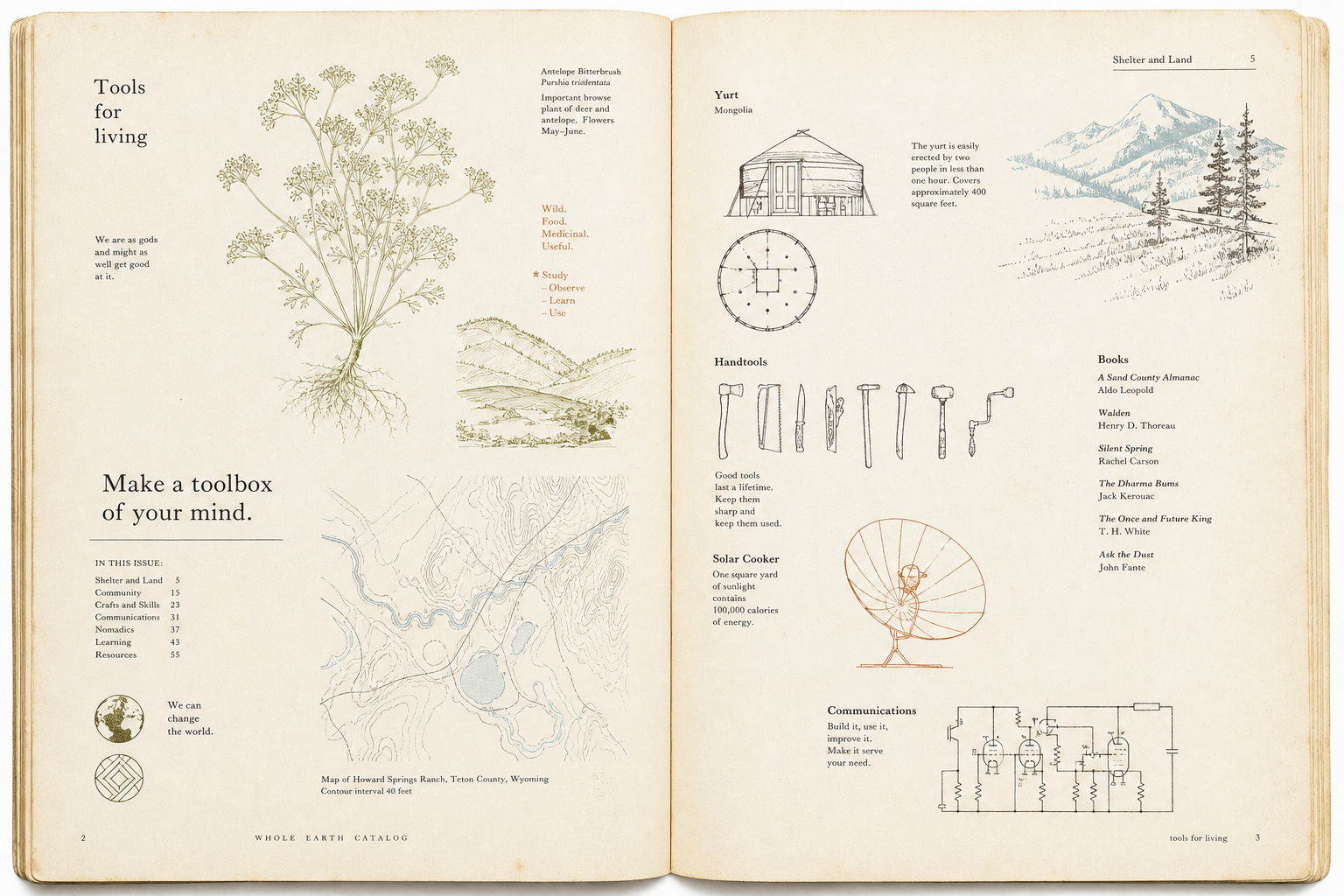
The Whole Earth Catalog is one of those printed objects that can resemble a magazine while really functioning like a toolbox on paper. Wikipedia gives September 1, 1968 as the first issue date, while the Internet Archive metadata identifies the complete first issue explicitly as Whole Earth Catalog (fall 1968). That first issue matters for Reetro because it uses print as infrastructure rather than as packaging: reading, browsing, comparing, and ordering become part of the same design idea.
A countercultural catalog rather than a conventional mail-order book
The official Whole Earth Index describes its archive as a nearly complete collection of Whole Earth publications, a series of journals and magazines descended from the Whole Earth Catalog and published by Stewart Brand and the POINT Foundation between 1968 and 2002. Wikipedia adds that the early catalog was first published by the Portola Institute and later by the Point Foundation, with distribution arrangements first through Penguin and then through Random House. Even that basic publishing history shows that the object was never just improvised hippie graphics; it quickly grew into a durable editorial system.
Why the pages feel different from ordinary advertising
Wikipedia summarizes the editorial focus as self-sufficiency, ecology, alternative education, DIY, community, and holism, and notes the slogan access to tools. Just as important is the mechanics of the page. The Whole Earth Catalog listed and reviewed products but, according to Wikipedia, did not sell the items directly; instead it printed vendor contact information next to the entries. That is what makes the surface feel both functional and editorial. The catalog reads less like standard advertising than like a designed network of recommendations, sources, and convictions.
The 1968 first issue as the start of an expandable print system
The Internet Archive metadata identifies the item plainly as the complete first issue from fall 1968, while the Whole Earth Index places it inside a much longer publication lineage. Wikipedia also notes that new editions appeared several times a year between 1968 and 1972. That helps explain why the first issue still looks modern: it behaves less like a sealed book than like an updateable printed interface. Lists, tools, books, machines, and supplier addresses are brought into a form that could keep growing without losing its visual calm.
Why it still resonates
The influence did not stop with the debut. Wikipedia states that the Last Whole Earth Catalog of June 1971 won the first U.S. National Book Award in the Contemporary Affairs category; the National Book Foundation also lists The Last Whole Earth Catalog as the 1972 winner in that category. For Reetro, that is less a trivia point than a sign of how strong the printed system was. These publications combined usefulness with a very particular page logic and image economy. If that kind of factual but visually charged printed surface appeals to you, it often leads to crisp posters or restrained framed art that makes information visible instead of hiding it.