
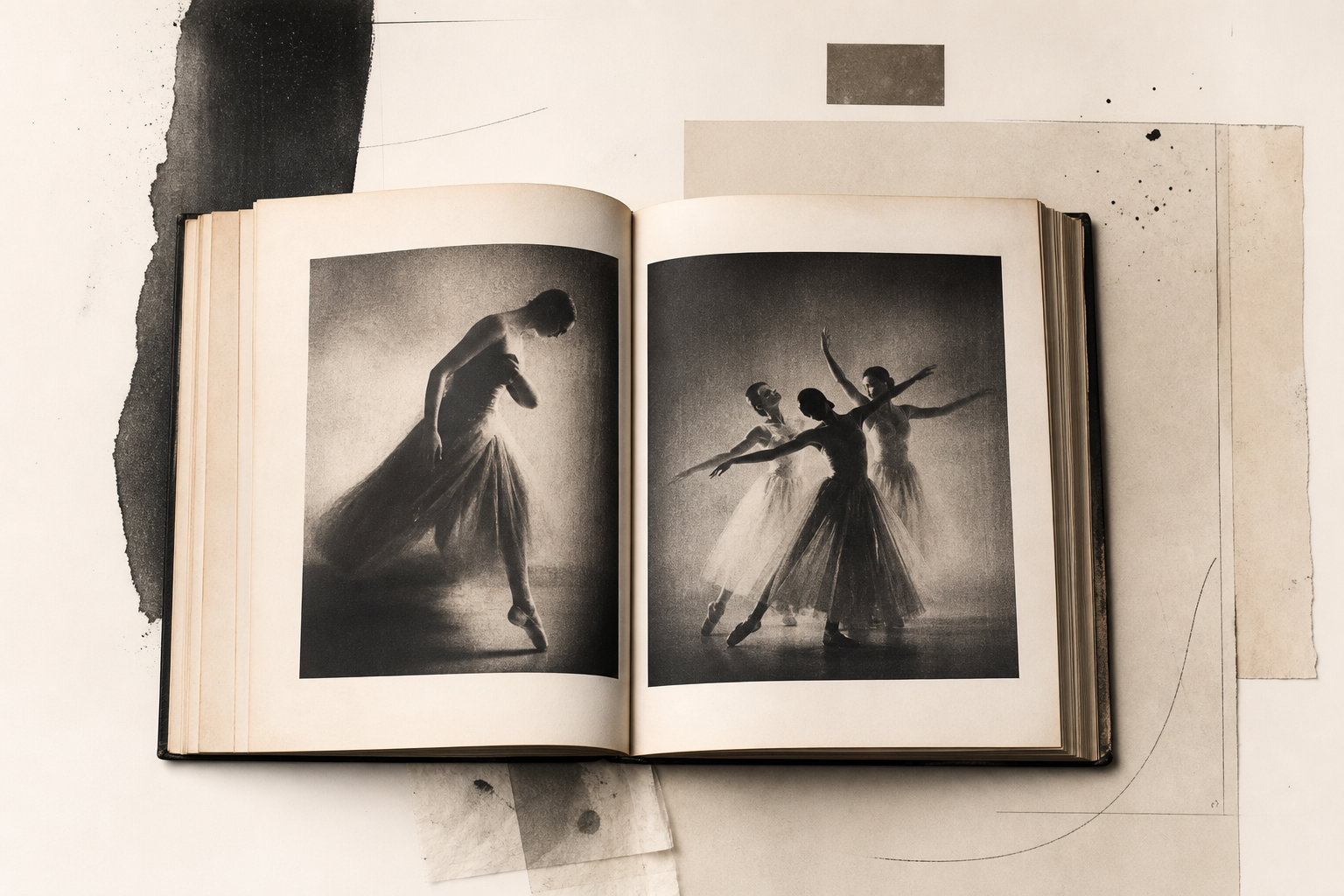
Ballet matters for Reetro because it does not simply collect images; it translates movement through print technique. Open Library records the edition as Ballet; 104 photographs by Alexey Brodovitch, published in 1945 by J. J. Augustin in English. Even that compact bibliographic line makes the object legible as a deliberately constructed printed book rather than a loose cluster of dance photographs.
1945, New York, 104 photographs
The basic facts are unusually clear. Open Library lists the recorded edition as 1945, published by J. J. Augustin, in English. Little Steidl adds that the first edition appeared in New York in an edition of 500 copies and identifies Edwin Denby as the writer of the text. For Reetro, that precision matters because Ballet becomes readable as a rare but firmly dated printed artifact, not as a vague design legend reconstructed after the fact.
A photobook built from five years of following the Ballets Russes
The Fondation Henri Cartier-Bresson describes the book as the result of five years in which Brodovitch followed the final American tours of the Ballets Russes in order to capture dance “in the moment.” Little Steidl specifies the repertory with works by Bronislava Nijinska, George Balanchine, and Léonide Massine, including Les Noces, Cotillon, and Le Tricorne. That makes Ballet feel less like a neutral archive and more like a tightly edited sequence of stage impressions.
Grain, smudges, and rotogravure
The book becomes especially Reetro in the way its printed surface is allowed to speak. The Fondation Henri Cartier-Bresson emphasizes that rotogravure intensifies the grain, permits traces and smudges to remain visible, and turns printing itself into an act of creation. Little Steidl describes the process even more materially: the inking and scraping mechanisms of the rotogravure press were used so aggressively that the images can read more like drawings than conventionally clean photographs. Those accepted imperfections are exactly what keep the object alive.
Why Brodovitch matters as a print figure
The Cary Graphic Arts Collection at the Rochester Institute of Technology describes Alexey Brodovitch as a pioneering art director whose twenty-five-year tenure at Harper’s Bazaar made him a key figure in editorial design history. That is why Ballet does not sit apart from his magazine work; it feels like a compressed version of it, with sequence, cropping, tempo, and white space behaving almost like layout decisions suddenly fixed into book form.
Why it fits Reetro
Ballet fits Reetro because it shows how elegant print can become when blur, grain, and visible process are not polished away. If you respond to quiet black-and-grey tonal fields, photographic motion, and paper surfaces that do not feel overly corrected, it often leads to restrained posters or calm framed art where tone, rhythm, and material presence matter more than perfect smoothness.